I pack our bags the night before. Sometimes I preload my pockets with snacks too.
Kids' stuff gets easier, but only when I have all the gear figured out ahead of time. And that includes my own stuff. Coffee and breakfast and snacks for mom and dad matter just as much as everything you're packing for your kid. You need energy for this adventure too. Make sure to give it to yourself.
And you know what? Sometimes fuzzy pajamas make great base layers.

The night before
Lay it all out. Everything. Here's the list:
Socks
Start here. Good socks matter more than most parents think. Merino wool is ideal. Smartwool or Darn Tough are my go-tos for kids. One pair on, one pair in the bag. See gear links →
Base layers
Merino base layers are awesome for kids. Synthetic hybrid materials are also a great option and are starting to come onto the market more and more. And yes, sometimes fuzzy pajamas actually work just fine. Don't overthink it. Icebreaker and Stio make up my kids’ base layer drawer, and 95% of mine too.
Mid layer
A good sweatshirt, maybe a pair of sweatpants or fleece pants on top of the base layer. Helpful if it's really cold, otherwise optional.
A brand worth knowing here: Hootie Hoo makes a Torrent Grid Fleece Set that works as a baselayer, a mid layer, and honestly as pajamas too. Reviews back that up. It's warm, wicking, stretchy, and built for real kid activity. See gear links →
Outerwear and waterproofing
Here's where most parents get misled. Gore-Tex is king — and that's true. But Gore-Tex is a brand, not a rating. And a great Gore-Tex jacket with a 10,000 waterproof rating isn't going to be as waterproof as a non Gore-Tex jacket with a 20,000 waterproof rating.
Here's how to actually read the numbers. The waterproof rating is how many millimeters of water pressure a fabric can withstand before it leaks through. The higher the number, the more water pressure it can handle. These numbers are testable and repeatable, which is why they matter more than any logo on the outside of the jacket. I'd recommend at least 15,000 for kids. 20,000 is better. Kids fall. Kids sit in snow. Kids drag their knees. They need real waterproofing.
There's also a breathability rating, usually shown right next to the waterproof number. Higher is better here too. A kid working hard on the hill in a non-breathable jacket is going to get soaked from the inside with sweat. Pay attention to both numbers together.
Three brands I've been really impressed by: Hootie Hoo, Trew Gear and Stio. All 3 make kids outerwear that actually fits a kid's body, holds up to real abuse, and performs where it counts. Our 5 year did his best to destroy the Hootie Hoo kit we had last winter. From the ski hill to kindergarten and back, the Hootie Hoo outerwear held up like a champ! See gear links →
Washing and maintaining your gear
This one most parents skip, and it matters. Washing your gear the wrong way will ruin it.
The best is to follow the instructions attached to any jacket or snow bibs. Empty all the pockets. Zip all the zippers. Use a technical wash soap like Grangers, Toko, or Nikwax. Regular laundry detergent strips the waterproofing right off. I try not to overdo it and spot clean when I can.
All of those brands also make a waterproofing spray that can extend the life of your jacket and pants after washing. Kids are super harsh on gear, and they should be. A good wash and re-proof can help extend to a second season or even hand down to the next kid. See gear links →
Hands
I personally like mittens over gloves for kids. They're warmer and easier to get on and stay on. But the reality is, like most things, whatever they are willing to wear and comfortable in is going to be the best option. I don't have a strong enough argument to win that fight every time.
What I will say: there is a huge difference between cute, fuzzy, fleece mittens and mittens or gloves with a protective outer shell. If you've ever sent a kid to daycare and come home with sopping wet gloves every day, you understand exactly what I'm saying. Flylow makes a really awesome pair of kids mitts. Try not to break the bank though, because they're going to outgrow them and they're going to destroy them.
I also tell parents they can always put a pair of gloves on underneath mittens to double up the insulation, going with thinner ones for the layer underneath.
And no matter what: always keep a backup pair in the bag. It's really easy to lose one. It's really easy for them to get wet on the inside by accident. A dry backup pair can save a day. See gear links →
Head
A hat or balaclava that fits under the helmet. A neck warmer. Both. I love Blackstrap balaclavas for kids — and I have one for myself too. See gear links →
Helmet and goggles
Pack them the night before. Don't leave this for the morning. If you haven't practiced wearing them at home yet, start now. A kid who's worn their helmet ten times before ski day is a completely different kid than one putting it on for the first time in the parking lot. There's too much to cover on choosing a helmet here, so we turned it into its own post. Read the helmet and goggles guide →
Ski boots
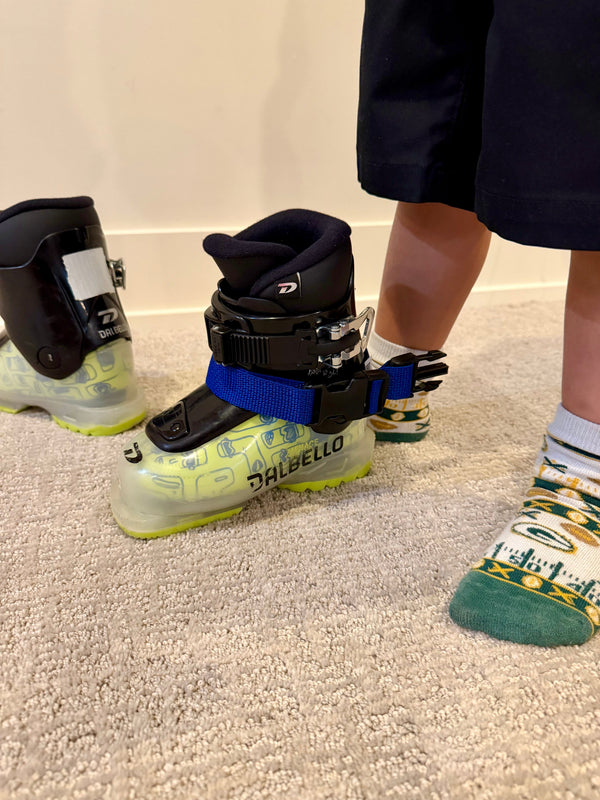
If you own them, bring them inside the night before. Cold boots are a nightmare to get on. Read: How to Choose Kids' Ski Boots →
Bags
One thing that makes the whole morning easier: a real boot bag. I've used Kulkea backpacks with my own kids for years now — and I use one myself too. The Speedstar is built specifically for this, with a separate ventilated compartment for boots so they don't turn everything else in the bag damp, plus room for a helmet, gloves, and layers. Everything has its own spot, and a big enough center pocket for that extra sweatshirt or change of clothes. See gear links →
And your own stuff
Don't forget your own gear. Nothing worse than getting there with everything your kid needs and realizing you forgot your own gloves. You're out there too. Coffee and breakfast and snacks for mom and dad matter as much as anything in the bag. Feed yourself. You need energy for this adventure. Make sure to give it to yourself.
Snacks
Snacks. Snacks. Snacks.
Pre-pack them the night before too. A couple of things for the car on the way there. A couple of things for your pocket on the hill. A couple extras in case you burn through everything or get to ski longer than you planned.
You cannot bring enough snacks. I have never in my life arrived at a ski day and thought "wow, I really over-packed on the food." It doesn't happen.
Easy pocket snacks: fruit pouches, granola bars, string cheese, crackers, goldfish. Anything that won't freeze solid and can be eaten with one glove on.
The morning of
Try to have a good breakfast. Something warm, something real. This is not the morning for a handful of dry cereal in the car.
Try to keep it casual. The energy you bring to the morning sets the tone for the whole day. If you're rushing and stressed, they feel it before you even get in the car.
How early do you think you need to leave? Set an alarm and then leave a little earlier than that. It always takes longer to get going than we think it will. Always. Add an extra half hour to whatever you're planning, especially with little kids.
The only thing that matters more than gear
Here's the thing that separates a good ski day from a hard one: attitude. Not gear. Not conditions. Attitude.
If you can go and do it with an open mind, the adventure of just getting there is over half the battle. Just getting boots on is a win. Getting to the parking lot can be a huge uphill climb before you even click into a ski, just getting onto the slopes is a win. Free yourself from only looking at the outcome. Focus on finding the fun along the way.
The fun can come in forms of an extra snack, a special breakfast on your way to the hill or packed with you, a special snack when you get there, a treat that you only have on your way to skiing or when you're skiing. Watching skiing, playing in the snow with your ski boots and gear on, managing the cafeteria in ski boots all build great skills in their own right. Remember, we're building a skier, not just teaching someone to ski.
More than any piece of gear, more than any snack, the most important thing you can bring to your kid's first ski day is an attitude that leaves your own expectations at the door and flows with your kid.
It might be your third season skiing together and they're still struggling to get beyond the same run. That's a parent feeling, not a kid feeling. It might be your first day and everything was going great until you got to the magic carpet and they refused to go up. You have choices there; you can push them past it, and honestly some kids need exactly that, a gentle push into something we know they're capable of, something we know they'll love. And for others, having the wisdom to take a break, build a snowman, shuffle around on the flat ground, even call it a day if you have to, can work wonders for the ultimate goal: growing a skier.
Giving kids the safety to explore on their own in this environment can be so beneficial to the lifelong goal of loving skiing forever.
Our kids are not going to look back and think about that one perfect turn they made when they were five years old. They're not going to worry about which year they conquered their first black diamond. They're going to remember how much fun they had when they went skiing with their family and their friends. They're going to remember that they always got hot cocoa when they were done. They're going to remember that Mom's pocket never ran out of gummy bears on the chairlift.
They are going to remember being a skier.

Pro tip: Ski Vitamins
Ski Vitamins are honestly one of the best things you can do for your kid on the hill.
Ski Vitamins can be any shape, color, or flavor you want them to be. They can be little rainbow colored circles with M's on them. They can be squishy little multicolored bears. They can be straight up chocolate chips in a Tupperware, and I've seen that work beautifully.
The key is: you call them Ski Vitamins.
When you call them Ski Vitamins, they take on a life of their own. They become an incredible tool: a motivation system, a reward, a reason to take one more run, go up for the first time, push past the fear at the top of a run. "I only have bottom-of-the-run Ski Vitamins today." "Oh shoot, these are chairlift-only Ski Vitamins, we're going to have to figure out where to sneak away and have them."
The trick is calling them something different. It gives them superpowers. And naming them Ski Vitamins makes it very clear that once we get in the car, they're done. We don't get them at home. We don't get them when we're not skiing. They're a very special thing for a very special purpose, and that adds to the magic and allure of skiing itself.
Quick checklist
The night before
- Ski socks x2 pairs (merino if possible)
- Base layers (merino, synthetic, Hootie Hoo fleece, or fuzzy pajamas)
- Mid layer / sweatshirt or fleece pants
- Waterproof jacket and snow pants (15k+ rating minimum)
- Mittens or gloves x2-3 pairs
- Hat or balaclava; neck warmer
- Helmet and goggles (pre-pack, pre-warm)
- Ski boots (bring inside the night before)
- A real boot bag to keep it all organized
- Your own gear too
- Snacks; car snacks, pocket snacks, extras
- Ski Vitamins
The morning of
- Good breakfast for you and the kids
- Coffee for the grown-ups
- Leave earlier than you think
- Keep it casual
On the hill
- Leave your expectations in the car
- Find the fun along the way
- Celebrate everything
If this is your kid's first time, the next thing to figure out is the gear itself. Start with the boots. Everything else follows from there.
Read: How to Choose Kids' Ski Boots →Gear links
Everything mentioned in this post, in one place.