Have you ever had a long discussion about which shoes your four year old should wear for the specific situation? Like, we probably don't need rain boots at the beach, and sandals might not be the perfect choice for six inches of fresh snow we need to go shovel? Have you ever spent more than 10 minutes “helping” a young child put on their shoes when it's time to go?
These are the exact reasons why doing boot work at home in your ski boots can take your first day on snow from miserable to magical, setting you up for an amazing core memory type of day.
How? Let's break it into two parts.
Part One: Getting the Boots On
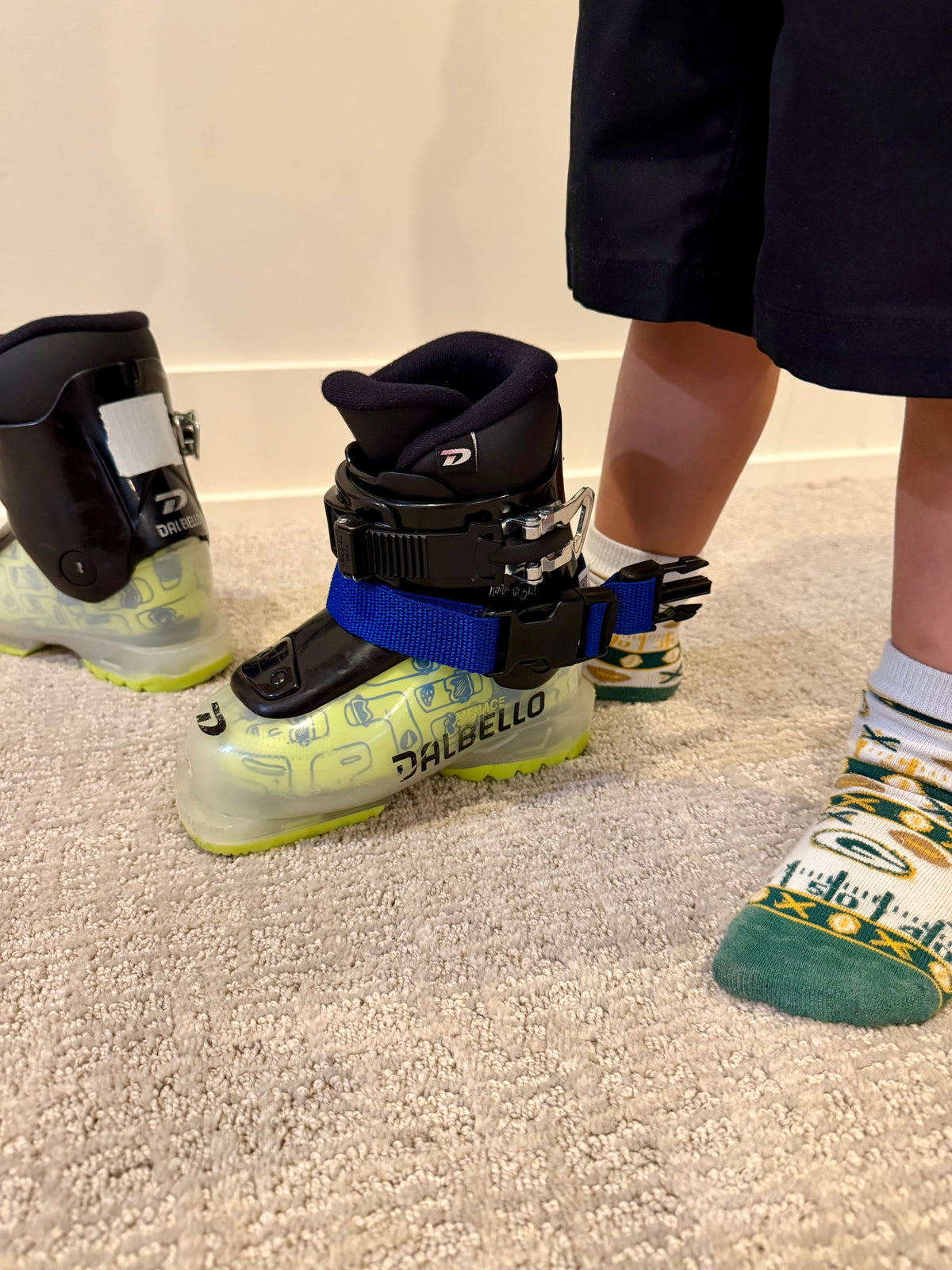
First part is putting the boots on. Get your nice, long, comfy sock on, and pull it up nice and tight. Get it smooth and then work on sliding your kid's foot into the boot. There's no pressure at home to go outside and ski, so this gets to be the activity. Take your time with it! Figure out how it's going to work for you and for them. A lot of times pulling the tongue of the boot out will create space for the kid to slide their toes in and stomp down on their heel. The pro tip I sometimes use is to pretend like there's a balloon under their foot, and they need to push their foot way down to crush and pop the balloon. The balloon is much less important than the stomping, so feel free to magically see a spider or a cupcake that immediately needs a good stomping.
Once you've got the boot on, or even just one boot, start buckling it down and get a feel for it. How tight is tight enough and how tight is too tight? Have you ever had your three year old tell you that the car seat's way too tight when you haven't even finished buckling it yet? I definitely have! Sometimes all we need to do to adjust the boot is to unbuckle it, say a magic word, and then buckle it right back down. Exploring these new boots and how to buckle them in the living room is much easier than at the ski hill when everyone's energy is sky high and we're excited to hit the slopes, sweating through our snowpants.

Grown ups can practice indoors too! Grab your Snap Two Ski Tethers and fit them to the boots. Tinker with the straps & fit the tether close to the boot with a little bit of tail to make clicking in and out easier. Much lower stress to adjust and play with the tethers inside when you're not racing the clock to get out on the slopes!
Part Two: Moving Around in Them
Part two is what you do when you have the boots on. You can do it with only one boot on if you want! Part two is all about exploration. Let them walk around on the carpet. What can they do?
- Walk around the room
- Spin slowly in a circle
- Jumping jacks
- Step over an obstacle
- Balance on a pillow or foam
- Play catch with a ball
- Lay down and stand back up
EVERYTHING a kid does wearing ski boots helps their bodies learn how ski boots work. The more comfortable they feel in moving around wearing the boots, the more comfortable they'll feel moving the skis.
Four Specific Movements to Practice
Squish the marshmallows in your boots. Stand flat on your feet and pretend there's an imaginary marshmallow between your shin and the tongue of the boot. (Bonus points if you put a pretend one in there, because who doesn't love a little make believe!) Now can you squish those marshmallows? Notice the difference between squatting down and pushing your knees over your toes. Can you get your knees to line up on top of your toes and keep your nose lined up on top of your toes at the same time? Just like Rudolph the Red Nosed Reindeer has to stick his shiny red nose out to lead Santa's sleigh, see if your child can get their nose out in front of their knees and toes. The Rudolph nose can be a good cue to stop them from bending their legs and squatting down.
Tipping your feet. Can you tip your foot inside the boot and get the boot to tip with you? Can you tip one foot at a time? Start tipping toward your little toe and see if your other foot can follow, tipping onto its big toe. If you stand on a pillow, it can add a little extra excitement. When we tip our feet, we get our boots to move. What if we had skis on our boots? This is how we turn our skis on the snow, it's how we change direction.
Stand on one foot. Can you lift your foot? Can you lift the other foot too? Let's have a one legged flamingo contest; who can stand longer on one foot? This introduces the concept of balancing over the outside ski, but in reality, you're just two flamingos standing in a living room, hopefully next to a nice warm fireplace.

Side-stepping. Lay out tape like rungs of a ladder and match your feet on the tape as you move them apart and bring them together. Or, lay out pencils or markers and step over them. In this sidestepping motion the key is to keep your feet parallel. This lateral movement will be key in getting back up the hill when they need to. Bonus points if you can tip their boots in the direction of their steps: tip the left foot onto the big toe and right foot onto the little toe when going to the right.
These are just four ideas to play with, but there's nothing wrong with just putting the ski boots on and having a tea party! Like I've said before, anything that kids do in ski boots helps them learn and connect better the body parts that make the ski boots move. Don't get discouraged if the games last less than five minutes, or if you only make it through one boot, or if you have to quit early for other reasons. All of the time getting familiar and comfortable in the gear helps.

If you have a miserable time just trying to get one of the boots on, I promise that this is a much easier thing to figure out, work through, and deal with, in the comfort of your own home, versus being at the ski hill doing the same thing in the crowded chalet in your snow gear.
The only goal here is to get more comfortable in these fancy new shoes that help us ski. A couple new movements to go along with the new boots, and maybe a great time to introduce a ski vitamin. Since you're wearing ski boots, you could probably try one. Just remember, ski vitamins are only for skiing, and once the boots are off, the ski vitamins go away. They're a valuable resource!
Snap a photo of your living-room boot work and tag us. We want to see it.
Share Your Snap Two Moment →