You're standing in a ski shop — or more likely, scrolling at 10pm — and you see an ad for a backpack harness and a pair of ankle tethers for a little more. Your brain does what every parent brain does:
"Well, I see these backpacks everywhere so they must work. But is the other one really worth it? What if I just used a jump rope? No, that's a dumb idea. Wait are his snow pants ripped? What do I need for dinner tomorrow? Does my kid have a runny nose today? Gosh, this is expensive. How do I carry all this stuff? Is my kid even going to like skiing?"
You're not doing it wrong. That's just what parenting feels like these days — buying ski gear for a toddler is the same, only colder.
Here's what I want you to know before you decide.

The real difference isn't the price
Both tools exist to solve the same problem. Your kid wants to ski, and right now they have no idea how to slow down or stop. You need some way to help.
But the way they solve that problem is completely different. That difference matters a lot more than it looks like from a product photo.
A backpack harness is a passive tool. It connects to your child's upper body, and when they go too fast or start to fall, you pull. It works the way a leash works. The contact point is high on their body, and the result (whether you mean it to or not) is that you end up dragging the kid rather than guiding them. Their weight gets pulled behind their feet. Their body tips back. They spend the whole run fighting to stay upright instead of learning to ski.
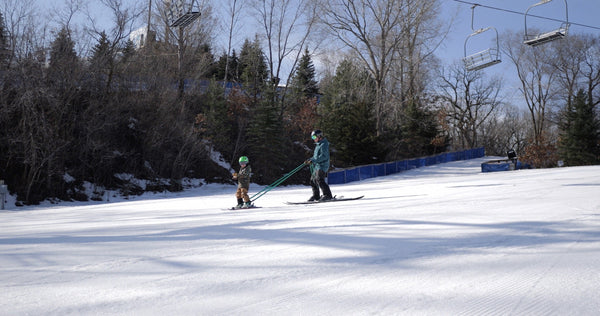
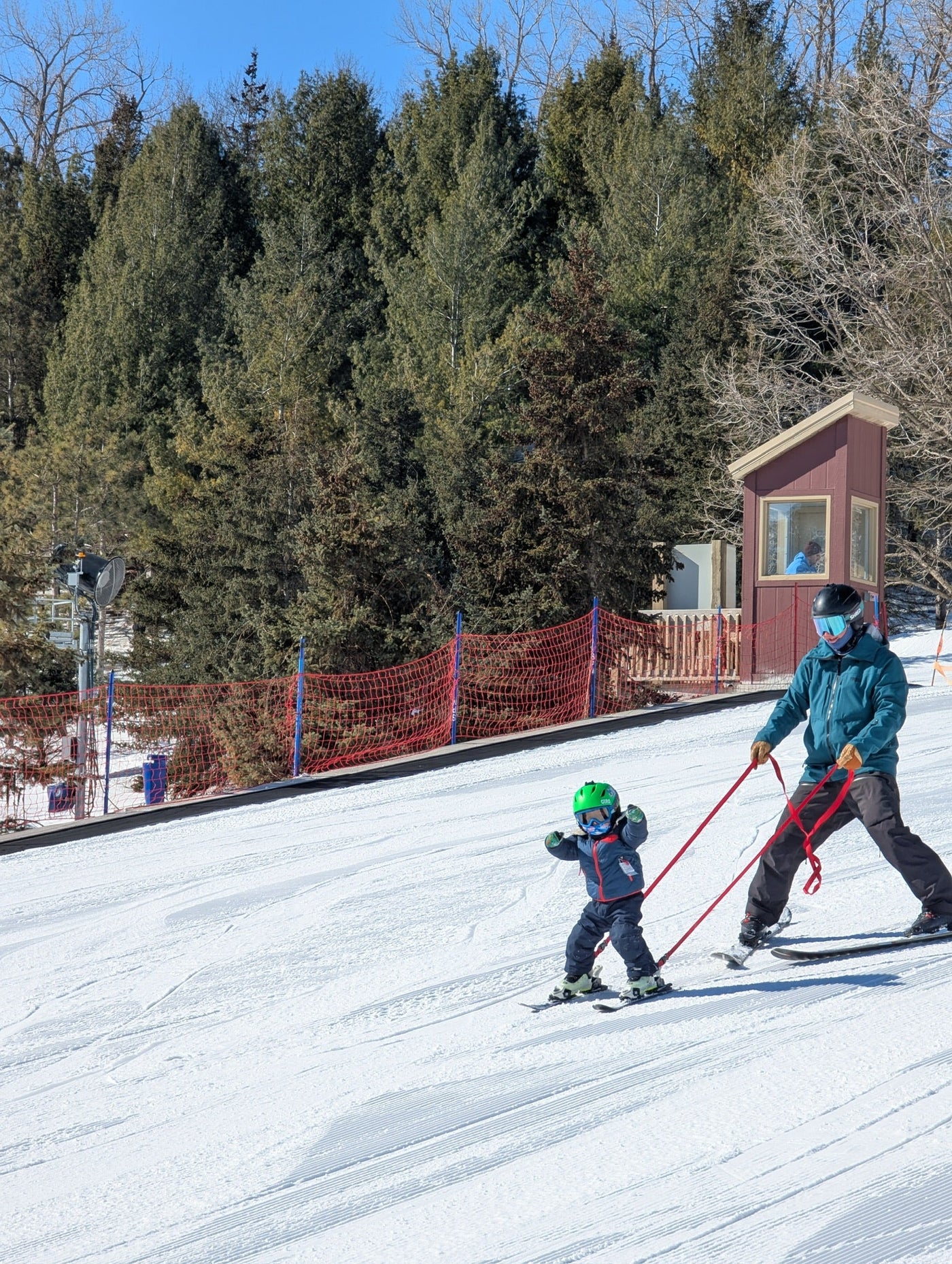
The Snap Two Ski tether is an active tool. It connects at the ankles, right where the boot meets the ski. The contact point is at the base of the body. When you hold the tethers and feel the tension, you're not pulling your kid backward. You're managing their speed from the ground up, the same way the ski itself is designed to work. Your kid's body stays over their feet. They can move their hips, their knees, their weight from side to side. They're actually skiing. You're just there to keep things from going too fast, so they can focus on the fun part: skiing!
That's the whole difference. And it's everything.
What you actually feel in your hands
Every parent who tries the Snap Two Ski tethers, or switches from a toddler backpack ski harness, notices it on the first run. Not after a few days. The first run.
What you feel is the control. You feel the connection: real, responsive, immediate, between your hands and where their skis meet the snow. And then, somewhere in the middle of a run, you feel something shift. The tension changes. They stop reacting and start moving. You can feel it in your hands the moment they start to move and ski on their own.
That's not something I can fully explain before you try it. But ask any parent who's used one of our tethers and they'll tell you the same thing.
What your kid's body is learning
Here's the part that matters most if you care about your kid actually learning to ski. Not just surviving the day.
Kids, especially toddlers, in backpack harnesses almost always run into the same problem. You can spot it from twenty feet away. They're skiing in the backseat, sitting in an invisible chair, riding down the mountain. They're burning out their big muscles and using all of their energy to ski with a limited amount of control. It increases the fear factor because they're not really in control and they can feel it. That position is visible from the lift. You've seen it. Most people just don't know what causes it.
Here's what causes it: when the connection point is high on the body, it pulls the child's weight behind their feet. Their skis run out ahead of them. Their hips drop back. And their body locks into that chair position to compensate.

Here's the part nobody talks about when you're standing in the shop comparing prices: what happens when you take the backpack away. That chair position doesn't go away with it. It stays. Kids ski that way for years, sometimes for life, until they actively work to change it. It becomes their skiing identity before they ever had a chance to develop a better one.
Ankle tethers put the connection point where skiing actually happens. At the boot, at the ski, at the snow. Your kid's upper body stays free to move about the hill. Their ankle, knees and hips can flex at their command, not yours. They find a real athletic stance because nothing is pulling them out of it. They're building actual skiing mechanics from day one, run after run, without realizing it.
We've watched this play out with thousands of families over almost thirty years at the Hot Cocoa Club and beyond. The kids on ankle tethers progress faster, build confidence faster, and ask to go one more time more often. Because they're actually skiing. And somewhere in their body, they know it.
What if you already have a harness?
Use it.
Genuinely. No tool is going to teach your kid to ski by itself. If you have something that gets your family out on the hill more often, that's what matters. The best ski tool is the one that keeps you coming back.
What I'd say is this: if you try the harness and something feels off; if your kid keeps tipping back, if you're pulling more than guiding, if the runs feel like a struggle instead of a ski day, that's worth paying attention to. It might not be your technique, it might be the connection point.
Give the Snap Two Ski tethers a shot if you want to see what changes. We think it's incredibly effective. But we're not here to tell you the thing grandma bought is garbage. We're here to help you ski more, stress less, and give your kid the best shot at falling in love with this sport.

The only thing that actually matters
The goal isn't to learn to ski at three years old so you can try out for the Olympic team when you turn four.
The goal is to fall in love with skiing so you don't know what it's like to not be a skier.
Whatever gets you there, we're for it.
If you want to see the ankle tether in action before you buy, we've got video of real families using it on real hills. And if you want to go deeper on how to actually use the tethers on the hill — technique, tips, what to do when your kid wants to go faster than you do — that's coming next.
Read: How to Use Snap Two Ski Tethers →